
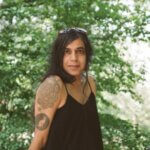
 Bishakh Som is an Indian-American trans femme visual artist. Her work has appeared in The New Yorker, We’re Still Here (the first all-trans comics anthology), Beyond, vol. 2, The Strumpet, The Boston Review, Black Warrior Review, VICE, The Brooklyn Rail, Buzzfeed, Ink Brick, The Huffington Post, The Graphic Canon vol. 3 and Little Nemo: Dream Another Dream. She received the Xeric grant in 2003 for her comics collection Angel. Her graphic novel Apsara Engine is the winner of a 2021 L.A. Times Book Prize for Best Graphic Novel and a 2021 Lambda Literary Award winner for Best LGBTQ Comics. Her graphic memoir Spellbound was also a 2021 Lambda Literary Award finalist.
Bishakh has illustrated two books about architecture: The Prefab Bathroom: An Architectural History and Cocktails and Conversations: Dialogues on Architectural Design.
Bishakh’s artwork was featured in solo shows at ArtLexis Gallery and at Jaya Yoga Center and in group shows at The Society of Illustrators in New York, the Bannister Gallery at Rhode Island College, Issyra Gallery, the Grady Alexis Gallery, De Cacaofabriek in the Netherlands and most recently at Art Omi in Ghent, New York.
BS: I’ve been drawing comics since I was a kid. In high school, I aspired to draw comics and illustrations professionally but that seemed like a pipe dream back then. My career path led me into architecture, which at the time involved drawing by hand—so it seemed like a good fit and a reasonable compromise. In 2011 or so, circumstances coalesced to turn me off of architecture as a practice, and I decided to take some time off to focus on art, comics, and illustration. During that time, I wrote and drew two graphic novels which finally came out in 2020 to some acclaim. In 2021, both books were nominated for multiple awards and have even won a few. So I think I made the right decision—and since that fateful turn in my life and career, I have, as the cliché goes, never looked back.
JRW: What is one of the most surprising things you learned while publishing your work?
BS: That there was, for real, an audience for the kind of work I was doing. That there were people out there who would, and did, connect with my work on a very emotional and essential level. That the stories I was telling which I initially thought were maybe too quirky and idiosyncratic to be appreciated by more than a niche audience actually resonated with a lot of readers. That sometimes not adhering to or fitting into a genre is a magical thing.
BS: Seek out other like-minded artists and writers. Form a writing or drawing club and set goals and assignments for each other. Meet up every two weeks, share your work, and give each other critiques. Discuss your craft. You can learn so much from each other—in terms of technique, style, materials, processes, approaches, attitudes—and most importantly, you can give each other the support you need to really thrive.