
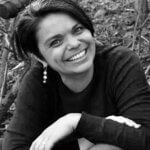
 Kelli Jo Ford is a citizen of the Cherokee Nation. Her debut novel-in-stories Crooked Hallelujah was long-listed for the PEN/Hemingway Award for Debut Novel, The Story Prize, the Carnegie Medal for Excellence in Fiction, The Center for Fiction’s First Novel Prize, and the International Dublin Literary Award. She is the recipient of an NEA Creative Writing Fellowship, The Paris Review’s Plimpton Prize, a Native Arts & Cultures Foundation National Artist Fellowship, an Elizabeth George Foundation Grant, and a Dobie Paisano Fellowship. She teaches writing at the Institute of American Indian Arts.
JRW: Which genre are you most passionate about?
KJF: I came up studying what’s often called literary fiction. Despite the limitations of that term, that’s probably where I’m most at home. But I love fiction that brings in all kinds of elements, however, it might be classified. I’m often most drawn to work that surprises me in some way, and lately, I find that happening when there’s a mish-mash of influences.
JRW: When did you first realize you wanted to be a writer?
KJF: I was encouraged by some wonderful English teachers I had in high school and junior high. I was always scribbling in journals, writing poems, and, now that I look back, exploring voices. I was naturally drawn to writing classes when I went to college, but I didn’t think of myself as a writer for a long time and didn’t imagine that it would ever be anything like a career. I simply kept writing, amassing a collection of stories. Not long after I became a mom, I started querying agents. That was about eight years ago and probably when I began to have larger aspirations about what I was doing. I think becoming a parent helped me focus my energy in a way. Kind of a now or never thing, maybe.
JRW: How has teaching at the Institute of American Indian Arts influenced your work as a writer?
KJF: I’ve been teaching there for about a year and a half now, so I’m not yet sure how it has influenced my work as a writer. I can certainly say that my students inspire me to work harder and read more widely, and be a better person in general. I’ve had the honor of working with some extremely talented, hard-working writers at the Institute. IAIA writers are already shaking up the world of publishing (Tommy Orange and Terese Mailhot are both alums) and I can’t wait to see what our current and recent classes of students will do.
JRW: What is one of the most surprising things you learned while publishing your work?
KJF: I learned that being an author is much different than being a writer. Most of us have to work very hard to promote our books, trying to ensure they have a life beyond the publication date. If we are lucky, we can keep ourselves quite busy doing so. I’ve been lucky to get to take my book on the Zoom road an awful lot. I’m grateful for that and for all the wonderful readers I’ve gotten to meet, but I’ve learned that I have to be careful to leave and foster space for the writing.
JRW: What advice would you offer new writers?
KJF: Read widely and often. Know that no work done is wasted. It will all help you better understand your story and continue to develop the skills you need to see the story through. Revision is where the real magic and understanding happens…and usually LOTS of revisions. That’s simply what the writing life is. And finally, find a good community if you can. And then, lean in. Be a good reader for your friends and find a couple of people who are good readers of your work. I still ask friends I made in grad school (15+ years ago) to read new work for me. Those kinds of relationships are invaluable for me. Writing is such a solitary practice. That’s one of the beautiful things about it. But if you want to let your writing out of your solitary room, then, for most of us, finding a few trusted readers is essential.