


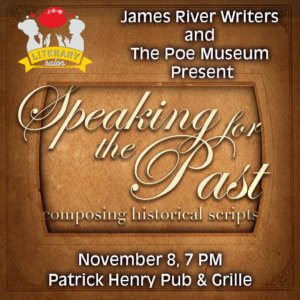
 First-person historical interpretation is a powerful and impactful teaching tool for groups of all ages, and is an effective way of engaging modern students with aspects of the past which can be difficult to grasp. Composing accurate scripts presents different challenges, particularly if the subject is a person who had been historically silenced. In this Literary Salon, historical interpreters Valerie Davis and Debbie Phillips will present on the processes of accurate script-writing and portrayal, particularly for women and persons of color, who are often silent in the written record.
WHEN: Thursday, November 8, 2018, 7 pm – 9 pm
WHERE: Patrick Henry Pub & Grille in the upstairs salon; 2300 East Broad Street in Historic Church Hill
COST: Free and open to the public (no ticket required)
SPEAKERS
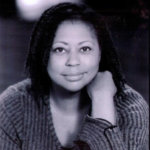
Valerie Davis is a gifted storyteller and actress whose powerful presentation \”From Tragedy to Triumph: the Martha Ann Fields Story\” has been shared with dozens of schools and churches to critical acclaim. She was written and starred in many One Woman shows, highlighting issues like domestic violence and also celebrating the bravery of women of color throughout history. Her workshops on storytelling are enlightening, and she has dedicated her work to the memory of her mother, Margaret A. Davis (\”Queen Margaret\”).
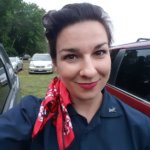
Debbie Phillips is a local historian and regional tour guide who has been composing historical scripts for nine years. Her characters include Eliza Poe, Edgar\’s birth mother; Elmira Shelton, Poe\’s first and last love; Patrick Henry\’s eldest child Patsey Henry Fontaine; Sally Tompkins, Captain of the Confederacy; Martha Washington, and more. Debbie manages public programs and rentals at the Edgar Allan Poe Museum in Shockoe Bottom, and enjoys engaging the public with history in unique and interactive ways.
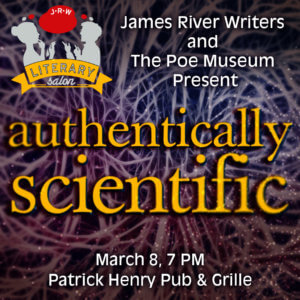 Writing about scientific topics presents authors with particular struggles—from finding reputable sources to properly conveying complicated information without losing one’s audience. How can a writer make sure they are interpreting their sources correctly while also expressing scientific information within its proper context? During the next Literary Salon, Dr. Kelly Lambert, a behavioral neuroscientist, will lead a group discussion focused on strategies to avoid many common pitfalls and integrate science into your writing in a way that will entertain audiences and won’t make scientists groan.
 Dr. Kelly Lambert, PhD
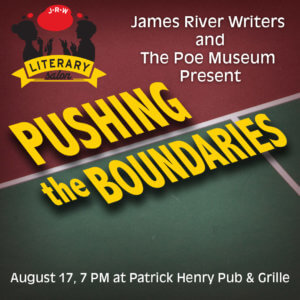 Many new writers are given the advice “to write what you know.” Yet, if you limit your writing to what you know, your stories, poems, or articles can become stilted and, just as importantly, you can become bored before you ever create the masterpiece you dream about. To fully engage your imagination and your audience, you must take risks with your writing. Whether you’re writing about people or creating characters who are different from you or trying forms and structures that break conventions, pushing the boundaries takes a deep understanding of yourself, your experience, and what you’re trying to achieve. In this literary salon, we’ll explore what you need to know before you start bending the rules and then do some writing exercises to give you the opportunity to push your own boundaries.
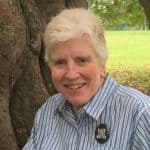 Annette Marquis serves as Program Director for James River Writers. She has an MFA in Creative Nonfiction from the Solstice Low-Residency MFA Program and is the author of over twenty-five books about computers and software, one memoir about civil disobedience, and numerous articles and essays on everything from how to talk to your IT person at work to dealing with the aftermath of a church shooting. As an intercultural competency consultant and trainer, Annette specializes in teaching how to write authentically about race, class, sexual orientation, gender identity, ability, and all the other identities that make us who we are. Annette lives in Henrico with her poet-librarian wife.