

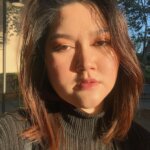
 Born and raised in Hanoi, Vietnam, Dr. Ly Thuý Nguyễn (she/they) is a bilingual queer scholar, educator, and artist whose work explores the complicated social and political lives of Vietnamese Americans during and after the Vietnam War. Ly received a Ph.D. from the department of ethnic studies at the University of California, San Diego. Their writing has been published by Asian American Writers’ Workshop, Feminist Press, and Ajar Press, among others.
JRW: When did you first realize you wanted to be a writer?
LTN: Growing up in postwar Vietnam, my childhood was spent indoors reading Vietnamese poetry and translated novels, from Leo Tolstoy’s War and Peace to Ethel Voynich’s The Gadfly. My mother is highly educated and an avid reader, so I had the privilege to have access to literary work. The written word has always provided peace for my inner world; I started writing before I realized that being a writer is a thing you can claim. As I pursued higher education and got my Ph.D. in ethnic studies, writing became an essential part of my career.
JRW: What subject are you most passionate to write about?
LTN: In terms of academic writing, the subjects I’m most interested in are refugees and immigrants’ politics of memory, lives after destruction, and intergenerational healing, with a special focus on queer narratives. In my creative writing, I explore the bilingualism of the worlds I occupy—in Vietnamese and English—thinking through how translation allows us to see different ways of life and dream in multitudes.
JRW: What is one of the most surprising things you learned while publishing your work?
LTN: The amount of revision that writers will be asked to do. No publication is “original” in the way that you might think; editors and reviewers will participate in writing with you. For me, this process was actually helpful in shaping my own writing process—I am no longer obsessed with putting down the perfect sentences or the perfect flow, knowing that I could potentially rearrange the whole piece and get rid of many sentences.
JRW: What advice would you offer new writers?
LTN: Read a lot, and when you do so, listen to the way words make you feel. Learn the styles you admire and practice them often. If you write nonfiction, know your history and the power structures that shape the historical contexts around your topic. If you write fiction, know your characters and the world in which they exist—try to make it as diverse and layered as you can.