
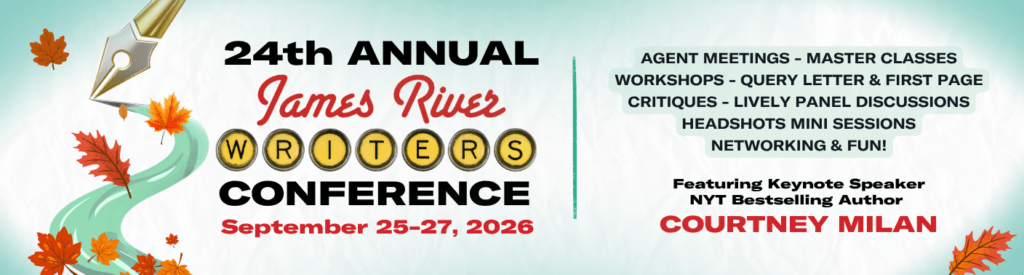
The James River Writers Conference is designed to help you reach your writing goals, whatever they may be. We have included a mix of sessions that cover both the business side of writing as well as craft. Tailor the conference offerings to your needs. While the conference add-ons (Agent One-on-one Meetings and Master Classes) need to be selected at the time of registration, you can decide which regular sessions to attend in the moment. Once you’ve registered, watch this website and your inbox for more conference fun and details, as well as tools to help you make the most of your experience! Schedule and speakers are subject to change.
Last day to register is September 22, 2026
Friday, September 25, 2026 | ONLINE Pre-Conference Master Classes
9:00 am–4:00 pm Eastern | Master Classes (Premium Add-On)
See schedule and pricing for Pre-Conference Master Classes HERE. You must register for these ahead of time to secure your spot. You may choose to register for Master Classes as an add-on to your in-person conference ticket or, if you’re unable to attend the in-person offerings on Saturday and Sunday, you can purchase Master Classes by themselves. We have nine online Master Classes to choose from.
Saturday, September 26, 2026| In-Person at the Greater Richmond Convention Center
8:00 am–8:30 am
Newcomers Welcome
Are you new to the James River Writers conference? Join us for a brief overview of what to expect during the conference weekend.
Host: Julie Valerie
Room: E10D
8:45 am–9:15 am
Welcome and 2026 Awards Presentation
James River Writers Executive Director, Katharine Herndon, welcomes you to Richmond, Virginia, for the 24th Annual Conference, followed by the presentation of JRW’s 2026 Awards. We will celebrate the Emyl Jenkins Award winner for inspiring a love of writing in others as well as the winner of the 2026 Best Unpublished Novel contest.
Opening Poem by Wendy DeGroat
Room: E10AB

9:30 am–10:30 am | Breakout Sessions & Workshop
Editing for Publication
Few writers manage a publishable draft without extensive editing. What weaknesses should you look for when you embark on your fifth (or fifteenth) revision? How do you keep from over-editing and deleting what’s working. These experts will help you identify strategies for streamlining or expanding and share advice on incorporating feedback.
Panelists: Rachel Kahan, Jon Sealy, Ravynn Stringfield
Moderator: Julie Valerie
Room: E10AB
Growing Your Audience
Whether you’re traditionally published, an indie author, or some combination, it’s essential that you put in the work to grow your audience and keep them coming back. Our panelists will offer a variety of suggestions and approaches, from building reader relationships in person to using social media and newsletters effectively. Come learn marketing tips from the pros.
Panelists: Kristi Tuck Austin, Isabel Klee, Courtney Milan
Moderator: Alethea McCollin
Room: E10C
Twice as Nice: Dual Timelines and Narrative Structure
It’s hard enough to create one linear plot arc, but some stories work best with a second timeline woven through the narrative. What makes writing dual timelines attractive, and how do you accomplish that without confusing your reader? Get pointers for layering your story for the most impact while maintaining continuity and pacing.
Panelists: Anne Blankman, Denny Bryce, Kris Spisak
Moderator: Clarissa Bannor
Room: E10D
WORKSHOP | Poetry as Power: Using Your Voice Before the World Gives You Permission with Richmond Poet Laureate Dr. Maurice “Moeflowz” Brown
This workshop will give you something deeper than just “poetry is self-expression.” It will open the door to talk about writing as identity, confidence, resistance, healing, leadership, and community. We’ll address questions like:
- How do writers find their voice when they are still figuring out who they are?
- Can poetry help us process life, pressure, grief, love, anger, culture, and identity?
- What makes spoken word different from written poetry on the page?
- How can literature help us speak truth without needing approval first?
- What responsibility comes with having a voice?
You’ll leave understanding that poetry is not just about sounding good. It is about learning how to say what needs to be said with honesty, craft, courage, and purpose.
Room: E11A
10:45 am–11:45 am | Breakout Sessions, Workshop
Honesty & Memory: Writing Truth in Memoir
One of the primary aspects of memoir is that it’s true. But you can’t know every truth you want to include beyond a shadow of a doubt. How can you be as authentic as possible when human memory is faulty and witnesses may not agree on past events? Hear from three accomplished storytellers who will share what truth means to them and how they get it on the page.
Panelists: Wilbert L. Cooper, Isabel Klee, Julietta Singh
Moderator: Annette Marquis
Room: E10AB
We’re All in This Together: The Power of Literary Community
If there’s one piece of advice we’ve repeatedly heard from the JRW stage, it’s that this writing gig is easier with community. Whether it’s finding a critique group, connecting with a mentor, commiserating over rejection, or decoding feedback, your writing challenges will be much easier if you don’t struggle through them by yourself. Our panelists will share their experiences with creating welcoming spaces as well as advice for being good community members.
Panelists: Cynthia Henebry, Joey Merlo, Eric Smith
Moderator: Demetrius Frazier
Room: E10C
Lyrical Language: Writing Effective Description
To paraphrase Stephen King, engaging the reader with your descriptions isn’t just about “how-to,” it’s about “how-much.” In the right hands, a little description can go a long way, and an in-depth description can be transportive. Used poorly, descriptions fall flat, slow your pacing, or (horror of horrors) end up being skimmed or skipped. How do you use language to its greatest effect when describing people, places, and things?
Panelists: Rachel Beanland, Margot Douaihy, Robert Gwaltney
Room: E10D
WORKSHOP: Experimenting with Common Issues in Short Fiction with April Sopkin
Does your work receive the same critiques over and over? Let’s break this hour into three acts and address the common issues we all struggle with in our early drafts—protecting our characters, limiting the story to its premise, and settling for a tidy ending. Come ready to write on the spot! Plus, there will be a bonus issue with associated prompts for you to experiment with on your own.
Room: E11A
12:00 pm–1:15 pm | Genre Networking Lunch
Are you looking for some like-minded writers and poets to share your successes and challenges? We’ll provide areas for different genres of writers to gather during lunch as well as several friendly, somewhat extroverted individuals to help get the conversation started. Grab your lunch and bring it with you!
Room: E10C Fantasy, Science Fiction, Horror, Mystery, Thriller
Room: E10D Literary Fiction, Historical Fiction, Poetry, Romance
Room: E11A Creative Nonfiction, Memoir, History, Screenwriting

1:30 pm–2:30 pm | Breakout Sessions & Workshop
Query Letter Critiques
Your query letter is your first chance to grab an agent’s interest and encourage them to read your work. In this panel, modeled on our popular first-pages critique, query-writing pros will review pre-submitted, anonymous letters and give their on-the-spot reactions to what works, what doesn’t, and whether they’d pass or read the author’s first pages. To submit your query for consideration, CLICK HERE.
Panelists: Agents Natalie Edwards, Saba Sulaiman, Marin Takikawa
Moderator: M.M. Finck
Room: E10AB
Magic & Mechanics: Staying Consistent When (Almost) Anything Goes
While fantasy can incorporate anything, it can’t include everything. Whether you’re digging into an epic tale or building on familiar mythology, you need to ensure your readers effortlessly suspend disbelief. How do you decide the parameters of your magic and fantasy elements so that your readers buy in and stick around?
Panelists: P. Djèlí Clark, Lauren Connolly, Cass Morris
Moderator: Bill Blume
Room: E10C
Free Range: Non-traditional Poetic Forms
Poetic forms can give you a structure to follow, but where do you start if you want to work without the guiderails? Three accomplished poets will walk you through the different ways they’ve gotten creative on the page. Get tips for experimenting with the look and sound of your words, and find out how to edit non-traditional poetry for impact.
Panelists: Nicholas George, Martheaus Perkins, Sullivan Summer
Moderator: Emily Okamoto-Green
Room: E10D
WORKSHOP: AI with Aggie Prakash
More information coming soon!
Room: E11A
2:45 pm–3:45 pm | Breakout Sessions
You’re the Boss: Successful Indie Publishing
One of the major drawbacks to traditional publishing is the ever-increasing length of time it takes to get your work out into the world. But how fast can you self-publish a book if you want to do it well? Our panel of professionals will guide you through their personal experiences and give you advice and sample timelines for navigating ebook formatting, cover art, editing, and more.
Panelists: Lauren Connolly, David Kazzie, Ran Walker
Moderator: Phil Hilliker
Room: E10AB

Built to Play: Crafting Stage-Worthy Stories for Writers of Any Genre
Why is it playwright, not playwrite? Because plays aren’t simply written. They’re built.
This panel explores playwriting as both craft and invitation: a form with unique structural demands that is accessible to writers of all backgrounds and skill levels. Our speakers will unpack what it means to be a builder of plays. We’ll discuss how to construct scenes and create effective, affecting dialogue. At the same time, we’ll make the case for playwriting as a worthy exercise, even if you are not aiming for the bright lights of Broadway. If you’re a novelist, poet, essayist, or screenwriter, this conversation invites you to think of playwriting as a powerful creative laboratory — a place to experiment, develop new skills, and explore the joy of storytelling.
Panelists: Eva DeVirgilis, Alethea McCollin, Joey Merlo
Moderator: Ellen Brown
Room: E10C
Words Matter: Activism & Political Writing
Many writers and poets feel called to use their words to effect positive change in these current times. What are best practices for being true to yourself while choosing an avenue that could have some impact? Our panelists will share their personal experiences with political writing and offer pointers on how you can use your unique voice and audience to make a difference.
Panelists: Wilbert L. Cooper, Annette Marquis, Martheaus Perkins
Moderator: Suzanne Boothby
Room: E10D
Putting the Story in History: Integrating Research into Your Work
What do you do once you’ve immersed yourself in the appropriate research and now have all these amazing details you want to share? How do you organize and record them? Which ones get used, and which get saved for another time? Our savvy panelists will talk you through choosing the most relevant details and weaving them into your work.
Panelists: Denny Bryce, P. Djèlí Clark, Sullivan Summer
Moderator: John Copenhaver
Room: E11A
4:00 pm–5:00 pm | Keynote
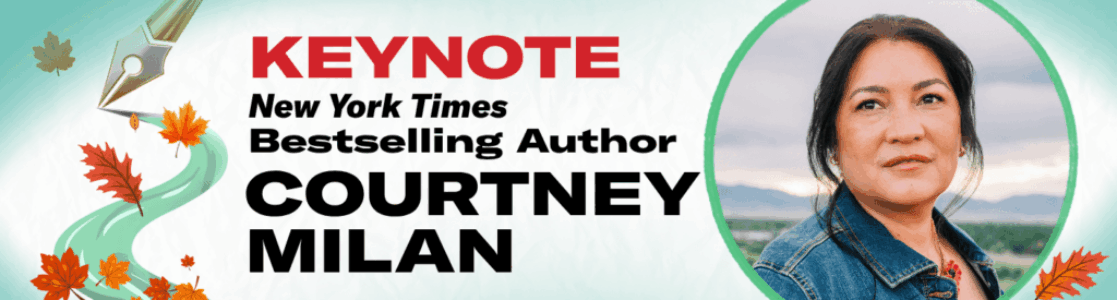
Keynote with Courtney Milan: The Making and Breaking of Generational Legends
Human beings define ourselves with generational legends: the stories we tell ourselves about ourselves. These can be things that are specific to our family (“in our family, we’re farmers”) or our country (“we are the greatest democracy in the world”) or our species (“humans can achieve the impossible”). Some of these legends are based on facts and evidence, some on hope and perseverance, and others on greed and subjugation. Story-telling is the way that these myths are transmitted from generation to generation. We story-tellers are tasked with a very special purpose: to make (and break) the legends that define who we are, and thus to define (and redefine) ourselves anew.
Room: E10AB
Sunday, September 27, 2026| In-Person at the Greater Richmond Convention Center
8:45 am–9:00 am
Welcome and Announcements
9:00 am–10:30 am | Plenary Session
First Pages Critique
The lively First Pages Critique has become one of the conference’s best-loved sessions. Agents and editors are swamped with submissions. How can your writing get their attention? Pre-selected first pages will be read aloud anonymously, and our experts will give on-the-spot feedback. Does the action start too early? Can the reader tell what genre or time period they’re in on page one? Find out what a good hook looks like and common errors to avoid.
More on submitting YOUR First Page HERE.
Panelists: Agents Natalie Edwards, Clare Mao, Hannah Teachout
Moderator: Bill Blume
Reader: Phil Hilliker
Room: E10AB
10:45 am–11:45 am | Breakout Sessions, Workshop
Establish & Engage: Writing Your First Chapter
After you’ve learned all you can from our popular First Pages panel, you may be left wondering how to pull off the rest of that important first impression. How do you keep reader engagement while grounding them in your world? Our experts will help you decide what to focus on and what to leave for later.
Panelists: P Djèlí Clark, Margot Douaihy, Eric Smith
Moderator: Phil Hilliker
Room: E10AB
Publishing Perspectives
In the changing world of publishing, authors have more choices than ever for getting their work out into the world. Hear from three authors who have published their work in a variety of ways, whether that’s with Big Five houses, small traditional publishers, or their own indie presses. Learn about the pros and cons of each path, and get your questions answered about the best choices for your own work.
Panelists: Stacy Hawkins Adams, Lauren Connolly, Virginia Pye
Moderator: DaNika Neblett Robinson
Room: E10C
Harnessing Point of View
Point of View can mean two things: (a) which character is telling the story and (b) what your narrative distance is. How do you balance these aspects to get the best narrator(s) for your particular piece of work? Should your main character be Gatsby or Nick? First person or third? A George R. R. Martin-like panoply or a single voice? Three craft experts will help you figure out who should tell your tale and how they should tell it.
Panelists: Denny Bryce, Robert Gwaltney, Jon Sealy
Moderator: Melissa Scott Sinclair
Room: E10D
WORKSHOP: Using the Hermit Crab form for Flash Fiction & Poetry with Martheaus Perkins
More coming soon!
Room: E11A
12:00 pm–1:15 pm | Lunch with Poetry Showcase
Grab your lunch and join us for poetry from our exciting slate of award-winning poets!
Poets: Dr. Maurice “Moeflowz” Brown, Rosa Castellano, Cynthia Henebry, Martheaus Perkins, Sullivan Summer
Room: E10AB
1:15 pm–2:15 pm | Breakout Sessions & Workshop
Emotional Payoff: Writing Compelling Character Arcs in Romance & Beyond
Romance novels aren’t just about getting to the Happily Ever After. They’re about characters with emotional wounds and ingrained fears who must grow to deserve their best possible futures. When your protagonists genuinely have something to lose, it’s more satisfying when they eventually win. Get tips from three romance experts for creating complex characters and convincing emotional journeys.
Panelists: Lauren Connolly, Courtney Milan, Saba Sulaiman
Moderator: Julie Valerie
Room: E10AB
Ready for Your Closeup: Public Speaking for Literary Artists
You’ve been invited to be on a conference panel, give a talk, or read from your work. How can you best prepare for your time in the spotlight? What are the dos and don’ts for making a good impression on your audience and your hosts? What should you know before you show up? Get tips on interacting with your potential readers and fans from the podium.
Panelists: Amy Lacey, Joey Merlo, Sullivan Summer
Moderator: Terry Menefee Gau
Room: E10C
Representing: Getting a Wider Variety of Writing Into the World
Sharing diverse work with the world is more important than ever. With over 60% of people in publishing being white, straight, cis women, it can seem daunting to find a home for work with a variety of lived experiences. Hear from three panelists committed to representing the actual world around us in all its joy, sorrow, weirdness, and beauty. Find out how you can place your own work and what you can do to make sure the widest possible range of representation is available.
Panelists: Margot Douaihy, Rachel Kahan, Addie Tsai
Moderator: Wendy DeGroat
Room: E10D
Workshop: How to Outline Your Novel with Bill Blume
When the desire to write fails because you can’t figure out what needs to happen next, sometimes the solution is to map your story’s path. Unfortunately, different stories demand different types of outlines. Author Bill Blume presents the pros and cons of six different outlining methods and how they helped him finish his novels and make them better. If you’re a pantser who would like to try plotting or a plotter who would like to explore some alternate options, this workshop will give you the tools you need.
Room: E11A
2:30 pm–3:30 pm | Breakout Sessions
After the Agent: The Author/Editor Relationship
Author and content creator Isabel Klee takes the stage with her editor, Rachel Kahan. Come hear what Isabel’s journey has been like, from capturing attention with her popular Instagram account @simonsits to the publication of her debut memoir, Dogs, Boys, and Other Things I’ve Cried About, in April 2026. Learn about best practices for making the author and editor relationship successful and get tips for navigating the long haul.
Panelists: Rachel Kahan, Isabel Klee
Moderator: Brynn Markham
Room: E10AB
AI: What’s It Good For?
We’ve all heard horror stories about agents deluged with AI-written query letters, contests and magazines swamped with AI entries, and would-be-authors who think AI could be the ticket to writing 200 books a year. What do writers really need to know about using AI? Are there ethical ways it can make your writing life easier without sacrificing your creativity or voice? Our panelists will give you the ins and outs, including the legal angles you need to know.
Panelists: Patricia Moore, Aggie Prakash, Kirk Schroder
Moderator: Suzanne Boothby
Room: E10C
Speaking Volumes: Writing Dialogue that Pulls its Weight
Great dialogue sounds realistic (even if it isn’t) and does as much work as your plot and characters. Two authors and a playwright will share how dialogue can move your narrative forward while providing subtext, conflict, and character development. Don’t settle for stilted exposition dumps when you can have sparkling repartee!
Panelists: Robert Gwaltney, Alethea McCollin, Laura Chow Reeve
Room: E10D
The Ultimate “Show Don’t Tell”: Writing for the Screen
There’s no time in screenwriting to elaborately describe the plot or your story’s surroundings. In fact, it’s a different way of putting together a narrative altogether. Discover how the ins and outs of visual storytelling, including how it can sharpen your prose writing by teaching you to think in scenes, cut unnecessary exposition, and let action drive character development.
Panelists: Wilbert L. Cooper, Robin Farmer, Terry Menefee-Gau
Moderator: Dae Newman
Room: E11A
3:45 pm–4:45 pm | Breakout Sessions
A Freelancer’s Toolbox: Essential Techniques for Writing & Selling Stories
This panel explores how you can best employ journalistic techniques, like an eye for detail, careful research, fact-checking, and narrative structure, to write strong, saleable prose. Our experienced freelancers will share practical tools for pitching and writing your compelling stories.
Panelists: Suzanne Boothby, Wilbert L. Cooper, Melissa Scott Sinclair
Moderator: Catie-Reagan King
Room: E10AB
Everything Matters: Writing Authentically for Young People
For young people, new experiences can feel like adventures and set backs like catastrophes. How do you capture the intensity of their experiences genuinely, without condescending or letting an adult focus creep in? Three panelists will discuss how they handle the plot points that propel or trip up their young protagonists with sensitivity and honesty.
Panelists: Anne Blankman, Ravynn K. Stringfield, Marin Takikawa
Moderator: Laura Q. Jimenez
Room: E10C
Tell Tale Poems: Writing Narrative Poetry
Storytelling through poetry is as old as the spoken word and still a popular and engaging way to reach your audience. Our three panelists will share how they choose their topics and themes and walk you through different ways to structure narrative poems. Learn how to make every word count while giving your tales richness and depth.
Panelists: Rosa Castellano, Wendy DeGroat, Cynthia Henebry
Moderator: Nick George
Room: E10D
The Anatomy of a Book Contract
A highly respected and award-winning entertainment lawyer will walk you through a typical book contract, including the clauses you should look out for. What should you push back on, definitely not accept, or be sure to include to get the most out of your contract? How has AI changed what writers should be aware of in their contracts? Get an overview of the best practices that will keep you safe.
Panelist: Kirk Schroder
Moderator: Kristi Tuck Austin
Room: E11A
5:00 pm–5:30 pm | Closing/Weekend Wrap-Up!
Some of our most beloved moderators from the conference will wrap things up for us, sharing their favorite tidbits from the weekend and offering their best advice for next steps as we say goodbye (for now!).
Room: E10AB