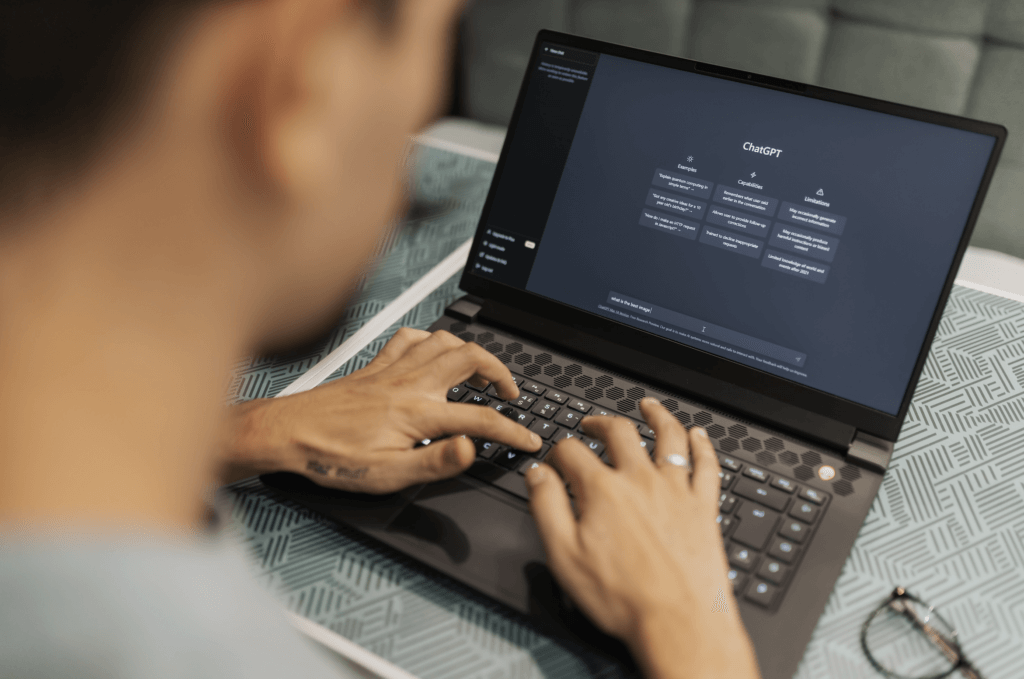
As someone who makes a living writing about automation and artificial intelligence (AI), I’m sure you won’t be surprised when I introduce you to my new writing companion.
A chatbot.
I heard that collective gasp.
But hear me out.
It’s true: Generative AI is now an essential writing tool for marketing professionals and authors, so I recommend you make a spot for it right alongside your laptop and the internet.
Nearly all of my company’s clients are embracing generative AI tools to augment and streamline work. My team of writers and editors is doing the same. And while we know this AI tool is NSFR (Not Safe For Research), we believe it’s very useful for some creative and writing tasks.
Look, I’ll admit that generative AI has some writing chops and can be very clever, but it’s not human intelligence. So it’s worth keeping a few points in mind.
It’s not a replacement for doing the work. You can delegate some of the writing process to generative AI, but only some. Humans still need to handle heavy revisions and apply their unique creative perspective to every piece.
The difference between disaster and greatness is human supervision.One compound word: Fact-checking. Generative AI can’t be trusted to deliver correct facts and reliable research. Humans must be responsible for accuracy.
It gives you more time to focus on higher-value work. AI doesn’t mind mind-numbing work, so feel free to delegate. Spend more time on your novel, and less time on tasks you hate.
It can spark creativity. AI can generate dozens of new ideas in seconds. If you’re stuck, your chatbot companion is a useful muse.
My team uses generative AI to improve productivity and kick start our creative work. We never ask our chatbots to write entire pieces. This AI works best for short, discrete tasks. If you’re wondering how to use it, try the following.
- Generate ideas. Wondering what to write about? Ask generative AI for a list of topics that interest your audience. Of course, be sure to vet the results with clients or readers.
- Jumpstart your writing project. Facing the blank page? Ask your chatbot to create the lead paragraph or suggest a way to frame your ideas.
- Refine copy. With a little work, you can train AI to write in a specific voice and style.
- Summarize raw material. Extracting key points from interviews, meeting notes, and reports is tedious. AI handles that task in seconds, so you can focus on being creative.
- Create titles and descriptions. Every piece of published content requires a number of additional items: meta descriptions, announcements, email copy, etc. We ask our chatbots to create several options, and then combine and wordsmith the AI copy to create a final draft. This works well for headlines and subheads too.
- Social media marketing. If you’re an author who needs to build a platform and you’re feeling overwhelmed, AI can make it manageable. Feed it an idea for a post, allow it to write the copy, and give yourself more space to focus on what really matters – your latest book.
These are but a few examples—and they’re only the beginning. We’re still experimenting and learning, and the technology landscape continues to evolve. As I write this, the immediate future of OpenAI is in question. If the nonprofit and ChatGPT disappear tomorrow, other companies offer the same capabilities. Plus, new tools emerge all the time.
Even though my chatbot has limitations, it’s a good writing companion. I appreciate the extra time and space it gives me to be creative. And honestly? After watching so many technologies evolve—from dial-up to high-speed internet, rotary phones to smartphones, and manual typewriters to laptops, to name a few—I can’t wait to see what my chatbot companion will be able to do next.
About the Author