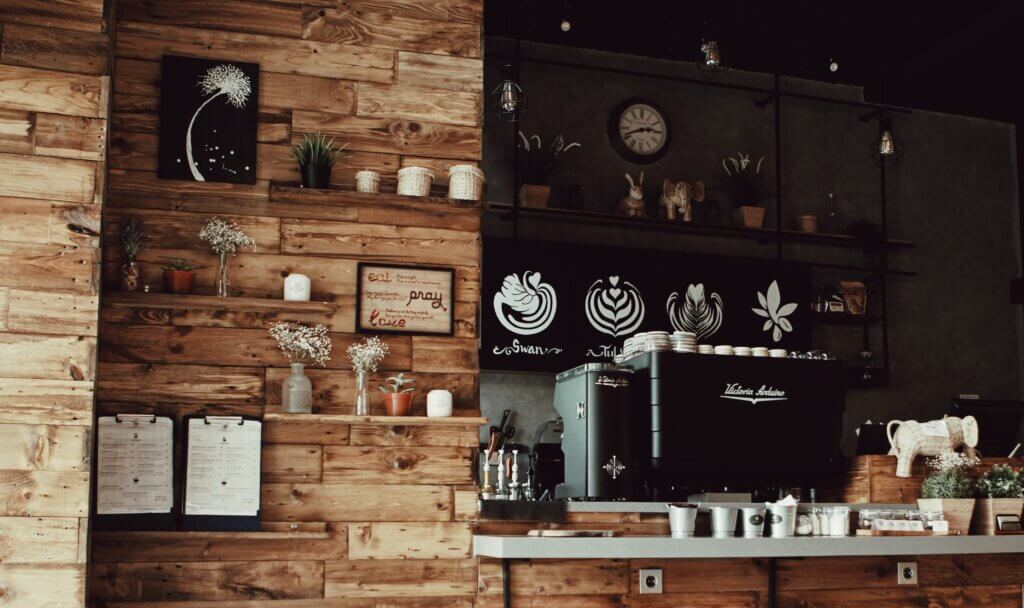
Sunday morning, The Fan. I enter the cafe off Cary St and order tea and a muffin. I hand my credit card to the young woman behind the laminated menu and she feeds it into a little white machine. I take my receipt and join the small crowd at the end of the bar, each of us waiting to hear our names called, our orders pushed forward.
The teller wears a silver necklace snug around her throat that reflects the overhead lights. The espresso machines and the steel shelves piled high with bread and bagels reflect light, too, but less elegantly, unattached to any tender collarbone. She also wears, the teller, an intricately patterned pink shirt that evokes the tiled wall of a palatial hammam. The teller dreams about a life away from the repetition of lattes and mochas and hot herbal tea. She harbors a sophisticated internal dialogue, her stream of consciousness constantly sparking judgments of coworkers, private analyses of customers, reflections deeper than those conveyed by stainless steel. Her self-dialogues synthesize into scenes, the scenes into stories, the stories into a book. In this life, or in another life, she becomes a writer, and her debut collection will draw comparisons to Jhumpa Lahiri.
When my name is shouted, unnecessarily loud, I collect my goods and sit down at the table furthest from the door. I turn my chair so my back leans against the wall. The wall is hard and cold. My tea is rooibos and my muffin is banana walnut. I take a sip and a bite. Both the tea and muffin are hot and sweet, in different ways. I’m in a peak state of breakfast, indulging caffeine and sugar but not yet subject to the crash the consumption of which will subject me to.
The cafe steadily fills up. Steam drifts heavenward from cups like so many mini-geysers. Nearby, a man and a woman sit on opposite sides of a rickety table. The man holds up his computer to show her his Google calendar. He seems proud of the rows and rows of color-coded meetings and appointments. They are an indicator, to him, of his importance, a proof point of his existence in the world of busy labor. In a year or two, or twenty, when he has more time, he plans to write a book, a deep dive into the capillaries of his industry. When his book is published, he’ll go on tour. He’ll visit the odd bookshop, but mostly he’ll deliver guest lectures at universities, the kind held on Tuesday nights at 7:30pm in the auditorium in the tech hall, as advertised in block print on colored paper glued to posts and walls.
“I’ve started buying more expensive soaps for myself,” he says now. He wears an olive turtleneck and scuffed New Balances. “I feel like that’s a minor expense, but one I get a lot of value out of.”
His companion, a plump, pleasant-looking woman, isn’t necessarily impressed by the man’s packed schedule or expensive soaps, but seems pleased just to be sitting with another human being in a coffee shop on a Sunday morning. She’s happy not to be alone, to be warm and caffeinated and fed. She’s wearing gray sweatpants and a flannel top. When it’s her turn to speak she looks up at the ceiling, then off to the side, anywhere but at him. He is perhaps a better listener than I want to give him credit for. He leans forward on his elbows and nods at the right times.
I slurp the first sips of my tea. I drink many different kinds of tea, but I still struggle to differentiate between oolong and green and black. I sip again, to see if I can memorize rooibos.
Coffee shops are incubators of grand existential dilemmas, the kind that transforms into six-figure book deals, or maybe I just want to see them as such because I spend so much time in them dreaming of seeing my name atop a bestseller list, an author renowned for his ontological insights. So many important thinkers have found inspiration in a cafe’s cozy confines. Hemingway hung out with Dali in a cafe. Godel astounded colleagues with his incompleteness theorem in a cafe. Simone de Beauvior showed up at Parisian cafes for warmth in the heat-starved winters of World War II. More recently, other writers, like Maggie Shipstead, turn up for the outlets and the wifi and the comforting background noise.
A group of three women enters the cafe, brushing off the outside. They join the line in a triangle that translates steadily up towards the register. One of the women is taller, more geometric. She looks like the kind of person who as a kid would’ve been described as all knees and elbows. She crosses her arms and angles her neck to lower herself into the conversation with her peers, who are both shorter. She wears loose jeans and a sweater that she struggles to fill out. Her hair is curly and piled up on her head.
She hasn’t told anyone, not even the girls she’s standing with, but she’s writing an essay about Paris. She hopes it’ll become part of a travel anthology one day, the personal variety a la Elizabeth Gilbert. She knows from reading other essays about Paris that the most important part of writing about Paris is invoking in the reader a sense of missing out, and so as she waits in line with her friends she mutely rehearses phrases like the golden honeyed sky above the Rue de la République. She’s never actually been to Paris, though, which makes the exercise totally prospective. She’s just borrowing phrases from her favorite French novels.
The turtlenecked man with the busy schedule one table over isn’t necessarily a good listener, actually. He just tries really hard every few minutes to be quiet for his companion. The ratio of his words to hers is probably six to one.
A man with slicked hair near the door steps outside, digs around in his pockets for a lighter, and draws the flame to the cigarette hanging from his mouth. The tip roars bright orange then fades. In college, he wanted to become, believed he would be, a renegade writer, a neo-Brat Pack-esque kind of revolutionary who’d draw comparisons to David Foster Wallace. His first novel would pick up where The Pale King left off, a musing on boredom and repetition that in its second printing would come with multiple pages of quoted accolades that poured in after the first edition hit nightstands and breakfast tables. But for now he’s just a man smoking a cigarette outside a cafe.
My muffin is half-gone. I don’t remember eating the first half. My tea is still warm, but I could chug it down now without fear of burning my insides. I’ve left the teabag in, and the liquid is strong to the point of bitterness. The rooibos flavor is distinct, but I’m not sure how. I pinch another bite from my muffin. Every time I visit this cafe I tell myself I’ll order something else. The laminated menu boasts an apple scone, an orange tahini cookie, a ginger dollop. But every time I step up to order, familiarity takes over and a banana walnut muffin it is. Plus I like that a couple of the baristas know my regular order by now, and I feel obligated to uphold my reputation for fear of losing it. Every time I visit the cafe I also tell myself I’ll start a novel soon. I haven’t.
Another man with torn jeans and long hair orders a coffee and sits down at a table in my sightline. He peels open a paperback. The cover is a fluorescent leaf against a black background, under the title ILLUSIONS, in all caps. It’s exhausting to even speculate what this book is about. It might be exhausting for him, too, reading it, because he quickly sets the book down, plugs in some headphones and picks up his phone. His thumb starts to flick. A glaze covers his face and he ceases to be interesting. In his most private moments, this man dabbles in poetry, typing stanzas out on his phone. Sometimes, when he’s feeling risky, he writes rhymes on paper napkins to satisfy some instinct he’s only recently recognized. Although it’s never happened to him, not for real anyway, he likes the idea of needing to write something down so urgently that only the closest available utensil and surface will do. In a few years, maybe, he’ll publish a chapbook, get commissioned for another. He fantasizes that a major university will one day buy his literary estate and dedicate a small wing of the English department to preserving and showcasing it. A new exhibition would debut each spring. Awed graduate students would spend long weekends poring over his notebooks, studying the napkins on which he first scribbled neuron-shattering poetry on in cafes like the one we’re both still in now, both still ensconced in the dreaming phase of word-oriented careers.
The barista shouts Cassidy. I scan the room, but nobody steps forward right away. I look for the tall angular woman and her friends, but they’ve left. So has the man with the cigarette and the man with a busy schedule and his bored companion, their dreams of books trailing invisibly behind, evaporating with the morning.
Even before the age of computers, printing presses had pumped out more books than any one person could ever read in a lifetime. Jane Austen to Zadie Smith. Homer to F. Scott. Dante to Dostoevsky. Baldwin to Bronte. Even if you read a book a day for the rest of your life, the dent you made in the stack would be minimal. The ease of a keyboard and the ubiquity of the internet have multiplied this number to a count that increases by thousands of volumes daily. And yet there are, simultaneously, an almost infinite number of books that have never been written, and will never get written, because nobody ever had the idea or the time or the will. Opening chapters rotting in abandoned word documents. Plot ideas with the life expectancy of a mayfly (not long). Oceans and oceans of nonexistent books.
The multiverse theory suggests that, if you give the universe(s) enough time and iterations, virtually every reality we could ever conceive of has already existed, is existing, or will exist sometime in the future. If we buy into this, then all those lost oceans, the books unwritten by coffee shop dreamers, will actually, eventually, in some universe, sometime, somewhere, become real. Virginia Woolf never wrote The Lighthouse, but the dude with slicked hair is a household name. Shakespeare was just some cat who hung out at theaters, but the young woman behind the bar has won Pulitzers.
My dream of producing my own books still feels fertile. I even type out pages sometimes. I came to the cafe this morning to do just that. When I walked in today I was sure that this time I’d leave with measurable progress, a strong uptick in my word count, but life did life and I only have a few incoherent paragraphs. I try to rationalize, but I struggle to see my incoherence as any kind of accomplishment. My sugar high is waning. The caffeine I drank is disorienting. I can’t sit still. I throw away the rest of my muffin and wipe my fingers on a napkin.
I pack up my stuff and head out on Cary St for a walk. My feet start moving but I’m not sure where I’m going. A pack of cars whisks by every forty seconds. A diesel engine roars somewhere in the distance. I look up. Someone’s hanging laundry out of a window. I look up further. The sky is a lovely blue. I can’t see any other universes, but I’m sold on the multiverse theory anyway. Somewhere out there, coexistent, or long ago, or still to come, is a universe in which I’m sitting in a cafe a lot like the one I just left. A beautiful woman sits down across from me. Her hair is dark and she has the most intriguing brown eyes, mini-universes themselves. She sips coffee from a chipped mug and pulls a book out of her bag.
About the Author